
The manner in which individuals share contact information is evolving rapidly. In the recent past, it was the norm to exchange printed business cards at meetings, events, or sales transactions. People are hardly keeping them nowadays.
Research conducted by Statistic Brain revealed that 88% of paper business cards are discarded within a week. This is a mere figure indicating a greater change. Paper cards are no longer compatible with the speed, convenience, and digital practices of contemporary networking.
Meanwhile, smart contactless business cards are becoming the new norm. They operate on tap or QR scan, are always updated, and live within a phone, which is carried all the time. That leaves a significant question among professionals and businesses: Will paper be completely phased out by contactless cards?
This blog analyzes the reasons behind the rapid rise of digital cards, what is better about them, and how BizCatchup tools are driving the change.
Why Paper Business Cards Are Losing Relevance
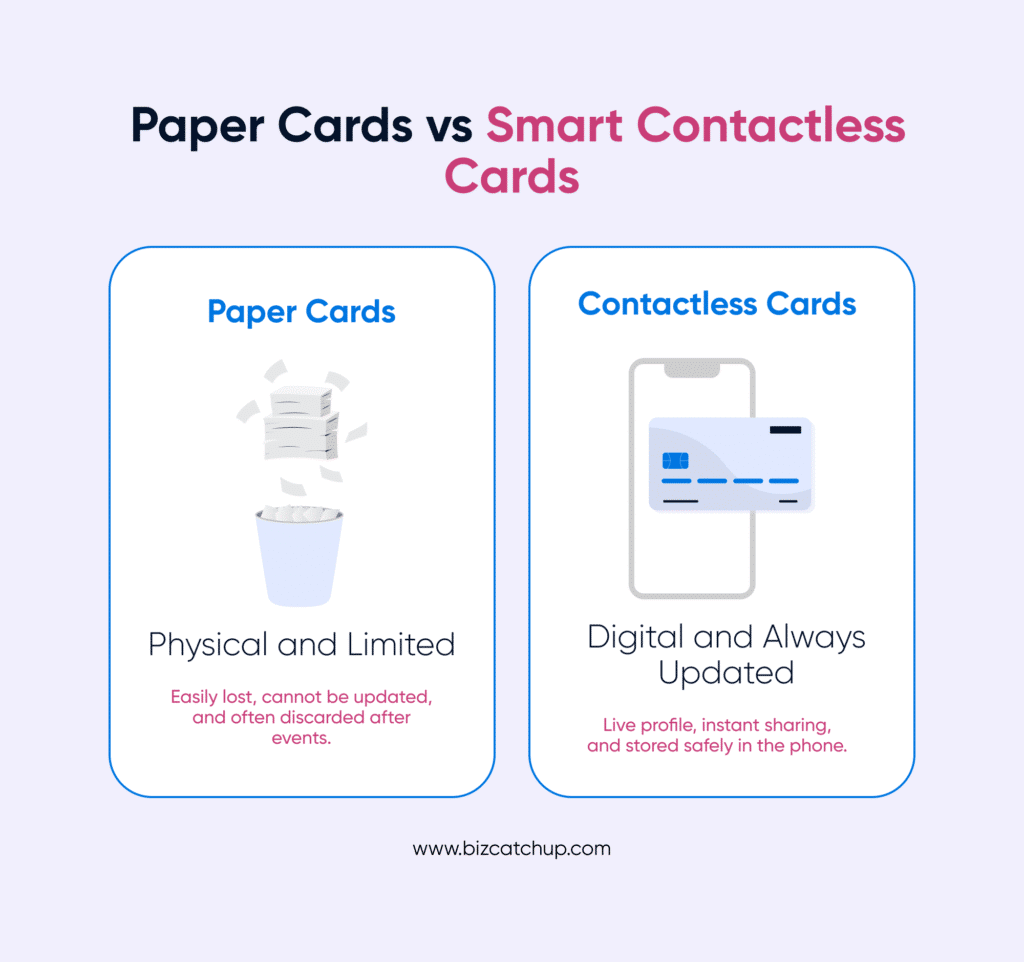
Paper cards used to be helpful as they were able to introduce yourself and leave something. However, today, they also have a number of limitations.
To begin with, they are lost very easily. During a conference, a person might get dozens of cards and then lose them or dispose of them later.
Second, paper calling cards do not update easily. When you change your phone number or company, you have to print new ones.
Third, they add to waste. It is estimated that billions of business cards are printed annually, and millions of them are wasted in landfills. This is an increasing concern for brands that are concerned with sustainability.
Most importantly, paper cards are no longer compatible with the way people want to be connected. Networking is now performed via phones, QR codes, apps, and instant contact saving. People desire something fast, searchable, and easy to store. Paper cards will not be able to keep up.
What is a Smart Contactless Business Card?
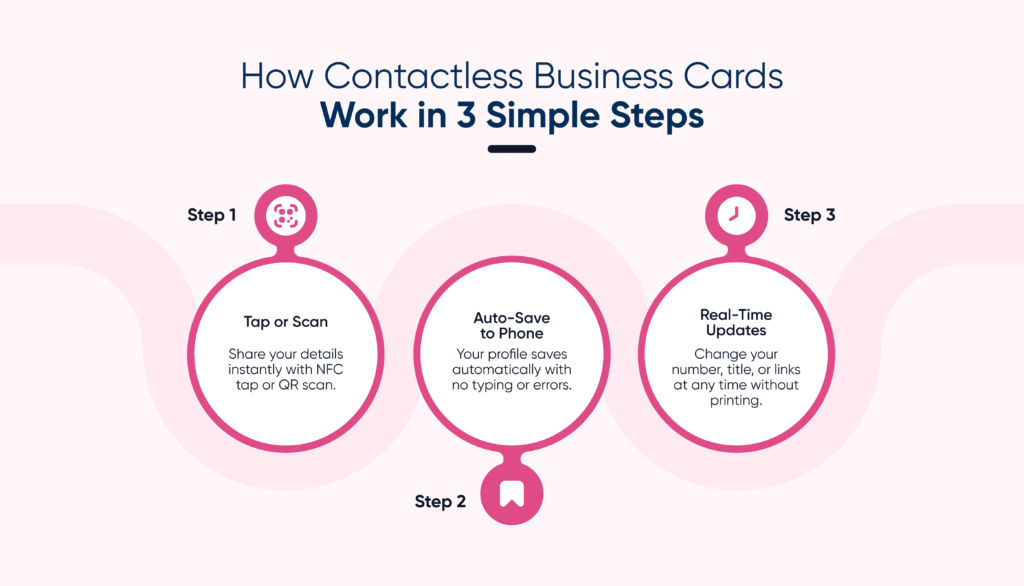
A smart contactless business card is an electronic card that provides your information in real time with a touch of NFC, a QR code, or a shareable link. They do not need to be handed a physical card, but rather they can tap their phone with yours, or scan your code and store your information directly.
It eliminates the process of printing, and you have complete control of what you share. You can change your job title, number, or site at any time without reprinting anything. The majority of contactless cards have profile photos, social connections, portfolios, and even analytics that indicate when a person views your card.
Since all things are stored in the phone, the probability of losing the connection is almost nonexistent.
Why Smart Contactless Business Cards Are Becoming Popular
Smart digital cards address nearly all issues of paper cards.
1. Instant Sharing Without Manual Typing
One tap or scan transfers your information. No typing, saving, or storing loose cards. It is quick and appears more professional.
2. Always Updated and Cost-Effective
There is no need to reprint another batch of cards. With digital cards, updates happen instantly, saving both time and money on reprints. This renders it less costly in the long run.
3. Better for the Environment
Contactless cards are much more eco-friendly since there is no paper involved. Several businesses have adopted them as part of their eco-friendly initiatives.
4. Analytics and Smarter Networking
In contrast to paper cards, smart contactless cards will tell you who saw your profile, what information they were tapping on, and how they connected to you. This simplifies follow-ups and makes them more focused.
5. Creates a Modern and Professional Impression
Carrying a smart contactless business card is an indication that you appreciate efficiency, are at ease with technology, and are concerned about smooth communication. It is positively distinctive.
How Bizcatchup is Shaping the Future of Digital Cards
The shift towards digital networking is picking up pace through sites such as BizCatchup. BizCatchup is a single tool that makes contact sharing simple, smart, and organised. It enables you to design a business card digitally, which can be shared immediately with a tap, QR code, or a link. You can also add your digital card to Apple Wallet for quick access anytime.
Instant card scanning is one of its greatest strengths. You can scan many physical cards simultaneously, and BizCatchup will automatically turn them into digital contacts. It then enriches and auto-tags these contacts to make them easy to search and manage.
Professionals and sales teams can also have BizCatchup automatically update contacts to CRMs such as HubSpot or Salesforce without having to upload them manually. All contacts remain linked, updated, and securely backed. This renders it an effective event, conference, and daily business networking tool.
BizCatchup basically forms a clean, ordered, and digital house of your whole network.
Will Contactless Cards Fully Replace Paper?
Digital cards are triumphing in nearly all spheres. They are more accurate, faster, simpler, and more sustainable, and more in touch with the tools that we use daily. A lot of industries have already transitioned to contactless cards as their primary means of information exchange, particularly in tech, consulting, events, startups, and sales.
Nevertheless, paper cards may not be completely phased out. In certain industries, gestures have not been replaced by other forms, particularly in formal environments. There is also a preference among a small number of people to carry around an actual physical card.
But the direction is clear. The smart contactless business card is gaining preference among most professionals. Paper cards are gradually becoming a reserve and not a main tool.
How Businesses Can Prepare for the Shift
To stay ahead of the curve, businesses can switch their teams to digital cards, support QR-based sharing, and use BizCatchUp to streamline contact management. A small stock of paper cards can be maintained by them in exceptional circumstances. This combination strategy gets them ready for a time when digital networking will be the standard practice.
Conclusion
The world is shifting to quicker and greener methods of communication. Smart contactless business cards provide an enhanced experience to both businesses and professionals. They are easily accessible, sustainable, and ever-present. Although paper cards can still exist in some contexts, the trend is increasingly going online.
The question most people ask now is not whether or not contactless cards will supersede paper, but when. Applications such as BizCatchup are assisting to ease that transition and make it smarter, more meaningful.
Quick Catch
1. How do Smart Contactless Business Cards work compared to traditional paper cards?
Smart Contactless Business Cards use NFC or QR technology to instantly share your details with a tap or scan. Unlike paper cards, they allow dynamic updates, integrating contact info, portfolios, and social links without needing reprints.
2. Are Smart Contactless Business Cards better for networking at events and conferences?
Yes. They streamline information exchange, reduce friction, and help professionals stand out. They’re especially effective at high-volume events where fast, seamless sharing improves engagement and increases follow-up conversions.
3. Can Smart Contactless Business Cards be customized for personal branding?
Absolutely. These cards support custom designs, brand palettes, logos, and personalized digital profiles. You can tailor landing pages to display your services, case studies, or links, enhancing your professional presence during networking.
4. Are Smart Contactless Business Cards eco-friendly compared to paper cards?
Yes. They significantly reduce paper waste and repeated reprints, making them a sustainable option for professionals who update their details often. One smart card can replace thousands of paper cards over time.
5. Will Smart Contactless Business Cards completely replace paper cards in the future?
It’s likely. As digital-first networking grows, Smart Contactless Business Cards offer convenience, analytics, and real-time updates that paper cards cannot match. Adoption is rising across industries, especially among tech-savvy and event-driven professionals.
