
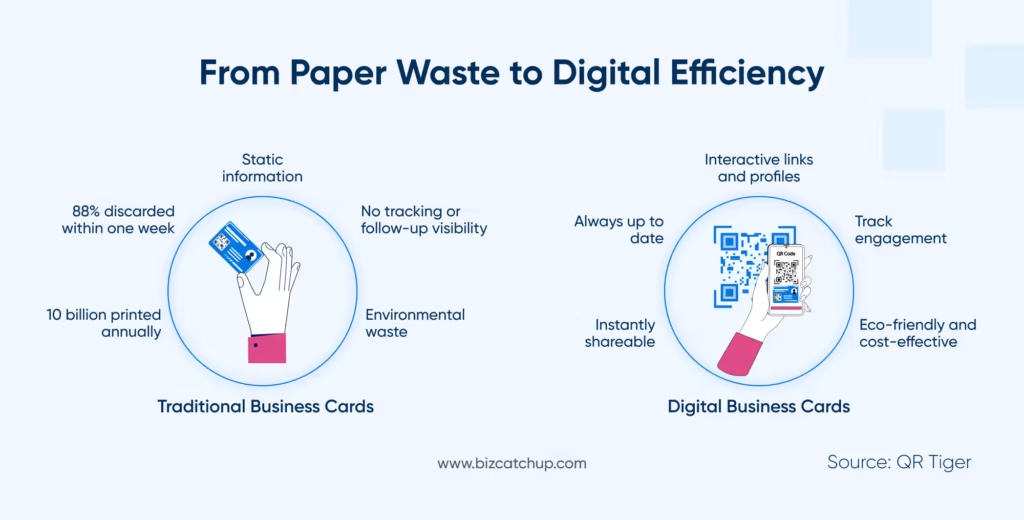
Approximately 10 billion business cards are printed each year around the world, but almost 88 percent of them have been discarded within less than a week of being received. Not only is this a waste, but it is also a strong indicator that the manner in which professionals interact and exchange contact details is evolving rapidly.
This shift is crucial to relationship builders, independent professionals, and operational connectors who find it easy to make meaningful and memorable connections. The simple business card has been a centuries-old stalwart of professional networking.
However, in the digitally interconnected, fast-paced world, there is a growing replacement of paper cards with more intelligent and effective ones. This blog discusses that journey and the reasons why digital solutions are becoming the choice of modern professionals.
A Brief History: How Business Cards Started
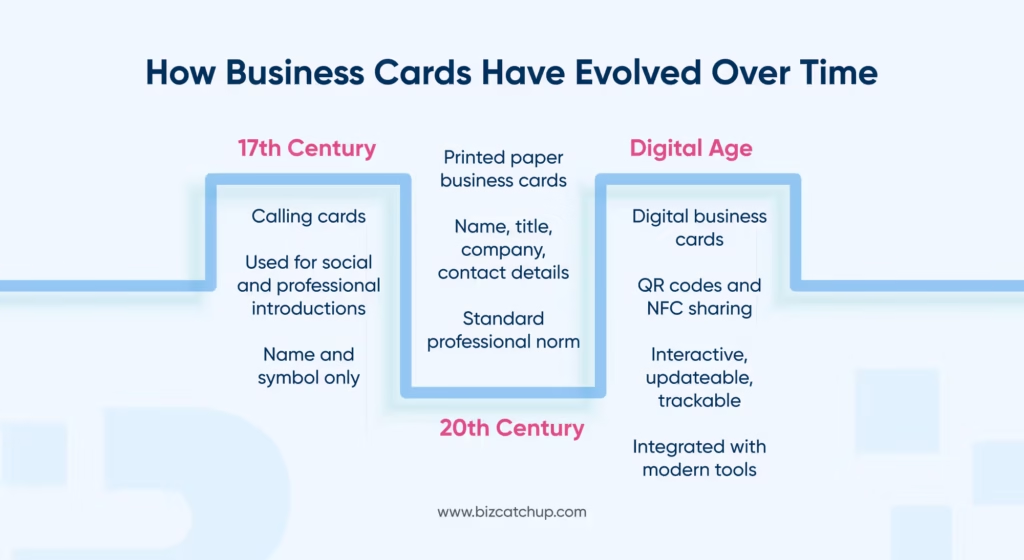
The history of business cards is a long and rich one. Their history dates back to 17th-century Europe, where calling cards were employed to announce social and professional presence or a visit.
During these initial times, social introduction was done by a mere printed card with the name of an individual and a symbol. These eventually became what we now know as a sizeable business card: a small, rectangular piece of paper, which holds the professional identity of a person. This includes name, title, company, contact information, and in some cases a logo or tag line.
This has been the norm over generations among professionals sharing information. They were material, individual, and could be detailed. To this day, a well-printed card can make a great first impression.
The Limitations of Paper Business Cards
Although paper business cards have a long history and are sentimentally important, they have drawbacks in the modern world:
- They get easily lost or forgotten. The majority of individuals discard them or lose them in days.
- They cannot be updated. An alteration in phone number, title, or email allows reprinting to take place.
- They create waste. There exists a true environmental cost with billions of cards being thrown away each year.
- They lack measurable data. You can not trace whether someone saved your card or not.
Paper cards work, but they are passive. They freeze a time frame, yet not the continuous narrative of a professional relationship or brand name.
The Rise of Digital Networking Tools
The emergence of smartphones, social media, and digital communication has changed the nature of connection among people. Paper documents are mighty, but the world is turning towards methods of making networking quicker, smarter, and more sustainable.
One of the major changes in this transformation has been the digital business card—a digital format of the classic card, which is saved and transmitted electronically. Recent market statistics show that more businesses (approximately 37 percent) and individuals (approximately 23 percent) have started sharing their contact information using a digital business card app.
Digital cards are interactive, updatable, and fit the age of remote work and hybrid networking compared to paper cards.
Why Digital Business Cards Are Gaining Ground
They Are Always Up to Date
The main disadvantage of paper cards is that any modification requires reprinting. Digital cards will completely remove this issue. Practitioners are able to update information on-site, and each recipient will receive the latest information.
You will not need to worry about phone numbers or incorrect URLs ever again.
They Offer Richer, More Dynamic Interactions
Digital cards are non-textual. They may contain links to be clicked, social media accounts, portfolios, video introductions, and so on. This makes a mere act of contact exchange a mini experience.
This is a smooth process, facilitated by NFC-enabled or QR shareable cards, some of which offer what is effectively a “smart contactless business card” experience, which instantly works when tapped or scanned.
3. They Are Eco-Friendly and Cost-Effective
Going digital saves a lot of paper. As billions of printed cards are thrown away annually, electronic options are an effective option to consider among professionals who are concerned about the environment and the cost factor.
It has no printing cost, no shipping delay, and no environmental impact from the traditional production processes.
4. They Integrate With Modern Tools
Digital cards are compatible with CRM, email, and contact managers. This allows the capturing of a new connection to be effortless and follow-up to be quicker and more precise.
It also promotes improved tracking and analytics. Conventional cards do not provide any insight as to whether an individual saved or took action on your contact information. Engagement metrics can be presented in digital cards where the professional can optimize their network policy.
Bridging the Old and the New
As much as there is a rise of digital cards, the traditional cards still hold sentimental and professional weight in certain quarters. A combination of both styles, i.e., carrying a short stack of nicely printed cards to use when making formal exchanges, and having digital cards for fast and effective exchanging in tech-friendly settings, works well among many professionals.
The selection is dependent on context, audience, and personal style. However, digital cards are causing a commotion in modern networking that focuses on efficiency, scalability, and sustainability.
What This Means for Relationship Builders and Connectors
Digital cards simplify the tedious networking that independent professionals, event organizers, and connectors who live off new relationships.
Social networks and applications such as BizCatchup allow practitioners to consolidate their online presence, facilitate interactions easily, and forget about the restrictions of physical cards. Such a solution facilitates more in-depth relationships and follow-through, which are key factors in developing long-term professional relationships.
Conclusion
The business card has become more than a simple engraved calling card, to a printed square, and currently to a dynamic digital operation.
All phases are indicative of the professional requirements and technology of the era in question. Digital business cards are not a passing trend. They have been created in reaction to the requirements of contemporary networking: speed, flexibility, connectivity, and sustainability.
The future of professional networking does not mean the rejection of tradition completely. It is of improving it—of making it smarter in the new world.
As a relationship builder, an independent professional, or an event connector, you will remain relevant, efficient, and memorable in all your interactions by learning and using digital networking tools. Networking is not merely providing information. It is initiating a dialogue. And the digital evolution is assisting in getting those dialogues started in a quicker, cleaner, and more significant manner.
Quick Catch
1. What are business cards and why are they still important in modern networking?
Business cards remain essential because they create a tangible first impression and establish credibility. In the digital age, they also act as gateways to online profiles, helping professionals start and continue meaningful conversations beyond first meetings.
2. How have business cards evolved in the digital age?
Business cards have evolved from printed paper formats to digital and app-based versions that can be shared instantly, updated in real time, and integrated with CRM tools, making networking faster, smarter, and more scalable.
3. What is the difference between traditional business cards and digital business cards?
Traditional business cards are static and easily lost, while digital business cards are dynamic, eco-friendly, and interactive. Digital versions allow users to share links, track engagement, and update information without reprinting.
4. Are digital business cards better for relationship builders and event professionals?
Yes, digital business cards help relationship builders and event professionals capture contacts instantly, follow up efficiently, and reduce friction during high-volume networking situations like conferences, meetups, and trade shows.
5. Can business cards improve professional follow-ups and long-term connections?
Modern business cards, especially digital ones, improve follow-ups by integrating with contact management tools, enabling quick sharing of updated information, and helping professionals stay top of mind after initial interactions.
