
If you’ve ever collected business cards at a conference or networking event, you know how quickly they can pile up in your bag or desk drawer. The challenge isn’t collecting contacts; it’s keeping their details organized and making sure you can find them when you need them. Learning how to digitize business cards helps turn those scattered paper records into searchable digital contacts, making it easier to follow up, maintain relationships, and keep your professional network accessible.
The act of digitizing business cards is something that can be done with the help of an application that can be downloaded onto your smartphone or other mobile device, as well as utilizing optical character recognition technology to convert your printed cards into digital contacts that can be used in your mobile, CRM, or cloud-based address book. The process is also usually very quick and takes less time than 10 seconds, provided you are using a well-designed app. Furthermore, there are companies like BizCatchup that provide digital business card services and AI card scanning along with CRM integration that will make it possible for you to save new contact details in the system.
This guide reflects the current generation of business card scanning apps, OCR accuracy standards, and CRM integrations available on iOS and Android.
What Does It Mean to Digitize Business Cards?
Business card digitization is the process of converting printed contact details into a digital format that can be stored on a phone, computer, or CRM. Using optical character recognition (OCR), a scanning app can extract details such as a person’s name, job title, company, phone number, and email address. This makes digitizing business data easier by reducing manual entry and keeping contact information organized, searchable, and accessible when needed.
Once the business cards have been digitized, instead of having a pile of cards, one creates a database of contacts that can be searched and shared anytime while being secure in the cloud. This is crucial because, according to IBM, businesses incur losses due to bad data amounting to approximately $12.9 million a year; thus, having proper contact information saved in digital form is not only a good option but vital for any business.
The technology used for converting business cards into digital form is known as OCR (Optical Character Recognition); when clicking a picture of the card or scanning the cards with scanning mobile or desktop programs, the OCR software gets the images.
Modern-day scanning apps/programs combine OCR technology with AI to read business cards and logos and even recognize different languages. Technology has reached such a level that the precision rate for scanning simple business cards in good lighting exceeds 95%.
When you learn about digitizing business data, you will also gain the fundamental knowledge about how to scan it (one business card or thousands of them) using this technology.
Why Should You Digitize Your Business Cards?
Before going into the step-by-step process of scanning your business cards, it is reasonable to understand why this tiny change in habits may lead to an amazing outcome for business people and entrepreneurs.
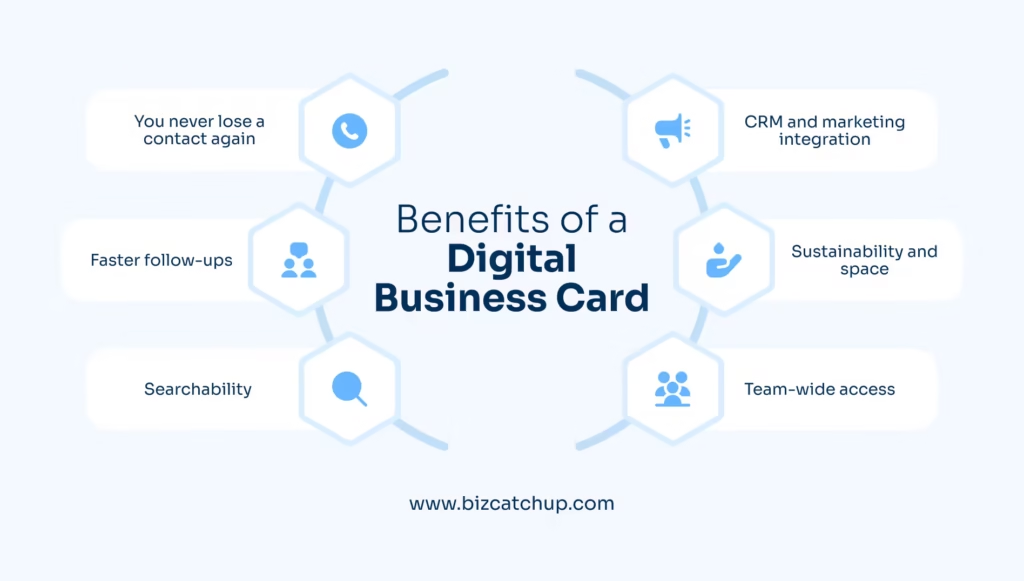
Never lose a contact: Paper cards get thrown away, forgotten in bags, or ruined by a coffee spilling all over them. A digital contact can be stored online and save all of that hassle.
Faster follow-ups: A digital business card can become a calendar item, an email, or a CRM lead in a couple of seconds after meeting someone.
Searchability: Try finding that “guy from the logistics conference” in a box with 400 cards. Now try typing “logistics” on your phone. The second option is better.
CRM and marketing integration: When you have business cards and turn them into digital contacts, they can go straight into your CRM.
Sustainability and space: Less digital cards mean less need to produce them and less storage space.
Access for your team: Digital contacts can be made available to any member of your team, not just the one person in possession of the card.
What Are the Best Methods to Digitize Business Cards?
The main strategies can be classified into four groups, from fully automated to fully manual. Most people use a combination of two options to suit their volume and accuracy requirements, but in order not to waste time on trial and error, you can directly refer to the BizCatchup section below in which you can find an app that can do all the tasks for you.
1. Smartphone Business Card Scanner Apps
Business card scanner apps enable card scanning with your smartphone’s camera. Optical character recognition technology assists in obtaining contact information and converting it into digital form. Depending on the specific application used, your contacts can be exported to your Google Contacts, Outlook, or to the customer relationship management software HubSpot or Salesforce. If you are someone who collects cards frequently from events, then you would also like this feature as it would allow you to do batch scanning, tagging contacts, and automatic synchronization.
2. Dedicated Business Card Scanners
Specialized card scanners (either desk models or portable ones) were created to scan cards. These scanners are generally faster when it comes to scanning a lot of cards at once. This is a great option for places such as reception desks, conferences, or organizations that have to process many cards in a day.
3. Google Contacts, Outlook, and CRM Import Tools
Today, a lot of CRMs (including HubSpot, Salesforce, and Zoho) and other contact platforms (like Google Contacts and Microsoft Outlook) have integrated the scanning function or allow importing a scanning app CSV file in bulk. This is an ideal option if you want not just “a contact in your phone” but rather a synced contact in your sales pipeline.
4. Manual Entry
An old method still works: write it down. This might take longer, and since it is done without any machine, it could lead to errors. However, this method could be very useful when there are a few cards that cannot be scanned.
How to Digitize Business Cards the Easy Way
First, you need to scan the business card. After scanning, you will need to check the resulting information and organize the contact, followed by uploading the details to your CRM system. BizCatchup combines card scanning, organizing the contacts, and implementing them into the CRM into a unified process thanks to its artificial intelligence features. The solution can benefit anyone with a lot of contacts as this would reduce the amount of time spent on manual updates.
In this manner you replace your manual process and essentially have a complete automated solution. Instead of being responsible for exporting files, creating CSV files, and entering the information into your CRM; you have a solution (BizCatchup) that will handle all of that for you the second you scan a document. No exporting to separate CSV’s, no reformatting of CSV’s, and no need to copy and paste into another application.
What Happens When You Download BizCatchup
Here’s exactly what the process looks like once the app is on your phone:
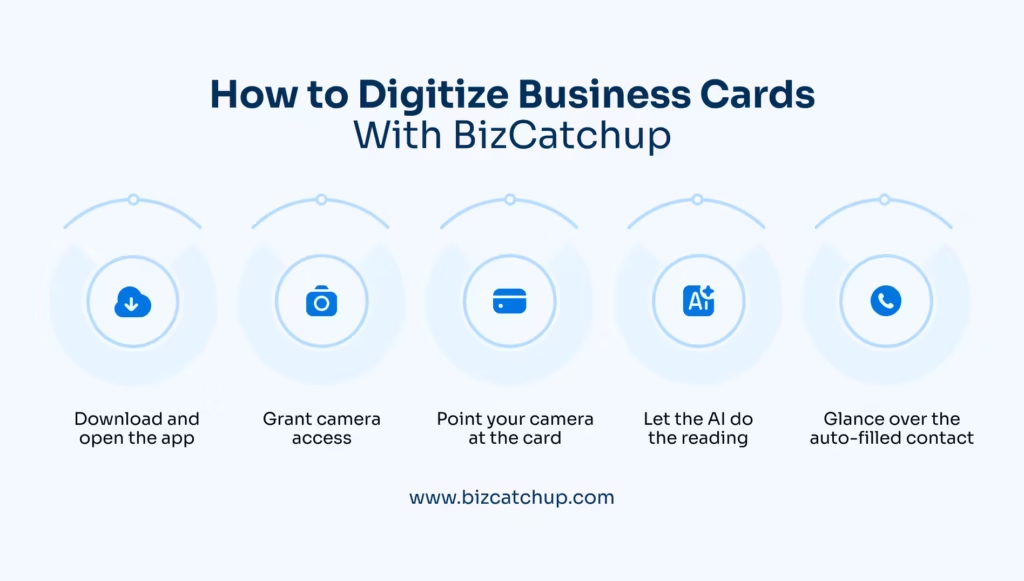
- Download and open the app. Get BizCatchup on the App Store or Google Play and create a free account; setup takes about a minute.
- Grant camera access. BizCatchup asks for camera permission once, so it can scan cards the moment you open the app; no repeated prompts.
- Point your camera at the card (or a stack of cards). Tap the scan button and hold the card, or several cards laid out together, in frame. BizCatchup’s AI detects each card automatically.
- Let the AI do the reading. BizCatchup scans both sides, runs OCR and AI recognition on names, titles, companies, phone numbers, and emails, and splits multi-card photos into individual contacts, all without you touching a keyboard.
- Glance over the auto-filled contact. The extracted fields appear on-screen for a quick check; correcting an occasional typo takes a few seconds, but there’s no manual data entry to do.
- That’s it, BizCatchup handles the rest. The contact is automatically tagged, enriched with business intelligence, and synced to your CRM (HubSpot, Salesforce, or your own database) in the background. You don’t need to export anything, open a second app, or remember to sync later.
Compare that to a manual process: sorting cards, typing each field by hand, opening your CRM separately, and uploading a CSV. With BizCatchup, downloading the app and scanning is effectively the entire workflow; everything after that first tap happens automatically.
Instant AI card scanning – Point your camera at a stack of cards, and BizCatchup’s AI scans multiple cards at once, reading both sides and converting them into structured digital contacts in seconds.
Smart contact management – Every scanned contact is automatically tagged and enriched with AI-driven business intelligence, so you can search, filter, and segment your network without manual data entry.
One-tap CRM sync – Scanned contacts flow directly into CRMs like HubSpot or Salesforce, so a card you scan at a conference can become a tracked lead before you’ve even left the venue.
Digital business cards and QR exchange – Beyond scanning other people’s cards, BizCatchup lets you create your own shareable digital card with a QR code or link, useful if you want to hand out a card and receive one in the same tap.
Secure export and backup – Your full contact list can be downloaded as Excel or CSV at any time, so your digitized network is never locked into a single app.
Team and analytics dashboard – Event and operations teams can manage shared cards, control access, and track card activity from a single dashboard, handy for businesses digitizing cards on behalf of a whole team.
Whether you’re a relationship-focused salesperson, an independent consultant, or an operations team managing contacts for a whole event, BizCatchup’s Built For pages walk through which setup fits your role best, and the How It Works page and Pricing plans (both open in a new tab) go into more detail on how the automation works behind the scenes.
How to Digitize Business Cards on iPhone (Step-by-Step)
iPhone users have several native and third-party options for how to digitize business cards on iPhone. Here’s the most reliable workflow:
- Open your camera or a scanner app. Apple’s Notes app has a built-in document scanner (Notes → New Note → Camera icon → Scan Documents) that captures a clean, cropped image of the card.
- Download a dedicated OCR-based scanner app if you want automatic contact creation rather than just an image. Search the App Store for a business card scanner app and choose one with strong reviews and CRM export support, or simply download BizCatchup on the App Store, which is built specifically for AI-powered card scanning and takes just a minute to set up.
- Position the card on a flat, well-lit, contrasting surface. Avoid shadows and glare; these are the biggest causes of OCR misreads.
- Capture the front (and back, if it has additional details). Most apps auto-detect the card edges and snap the photo automatically once it’s in focus. BizCatchup can even scan several cards laid out together in one photo and split them into individual contacts.
- Review the extracted fields. The app will populate name, title, company, phone, and email. Correct any OCR errors before saving; this typically takes 5–10 seconds.
- Save to Contacts or export to your CRM. Choose “Add to Contacts” for personal use, or select your CRM integration (Salesforce, HubSpot, Zoho) if you’re capturing sales leads. With BizCatchup, this sync happens automatically the moment a card is scanned, no manual export step required.
- Tag or group the contact. Add a label like “2026 Networking Event” or a specific tag so you can filter and follow up later.
How to Digitize Business Cards on Android (Step-by-Step)
The Android workflow is nearly identical, with a couple of platform-specific options:
- Use Google Lens for a quick one-off scan. Open Google Lens, point it at the card, and tap the contact information that appears. Android will offer to save it directly to Google Contacts.
- Install a dedicated business card scanner app from the Google Play Store for higher accuracy and batch scanning, especially if you’re digitizing more than a handful of cards. BizCatchup is available on the Google Play Store and adds AI-powered auto-tagging and CRM sync on top of basic OCR scanning.
- Enable camera and contacts permissions so the app can save directly without manual copy-paste.
- Scan the card in good lighting, holding the phone parallel to the card to avoid distortion.
- Verify and edit the auto-filled fields, paying special attention to phone number formatting and email spelling, which are the two fields most often misread by OCR.
- Sync to Google Contacts or your CRM so the record is backed up and accessible from any device signed into your account. BizCatchup handles this sync automatically, so there’s no separate export step.
- Set a follow-up reminder directly in the app or your calendar so the new contact doesn’t go cold.
What Are the Best Apps to Digitize Business Cards in 2026?
While specific app rankings shift over time, the strongest business card scanner apps in 2026 share these characteristics: high OCR accuracy across multiple languages, direct CRM export, cloud backup, duplicate-contact detection, and offline scanning support for events with poor connectivity. When evaluating a business card scanner app, prioritize:
- OCR accuracy on real-world cards; test it on a card with a busy logo or unusual font before committing to a paid plan.
- Export compatibility with the CRM or contact platform your team already uses (CSV, vCard, direct API sync).
- Batch scanning speed if you regularly digitize dozens of cards after a conference.
- Data privacy practices, since business cards contain personal contact details; check how the app stores and encrypts your data before granting camera and contacts access.
- Team-sharing features if multiple salespeople need access to the same digitized business data.
- Multi-language support if you attend international conferences or work with overseas suppliers, since OCR engines vary widely in how well they read non-Latin scripts and accented characters.
- How much of the process it automates for you. Apps that only convert a card into an image still leave you to manually enter the contact; apps like BizCatchup that scan, tag, and sync automatically cut that manual work out entirely.
- Free vs. paid tiers. Many apps offer a limited number of free scans per month before requiring a subscription; calculate your expected monthly volume before assuming the free tier will cover your needs.
How to Organize and Manage Digitized Business Cards
Simply scanning a card is only one part of the process of digitalizing business cards effectively; however, one would need a bit of organization to make them effective. Making sure that tagging, annotating, and setting reminders are consistent would help keep track of how a contact has been acquired and what has to be done next. In addition, a convenient method would let you find contacts and share information easily.
- Apply tagging methods in a uniform manner, including Grouping Tag (e.g. Event Tag), Type of Business Tag (e.g. Construction) or Lead Stage Tag (e.g. Cold lead, Follow-Up Sent, Client).
- Create contextual notes immediately after reviewing a contact. Contextual note such as “Intersted in Q3 Supply Contract” is much better than only having the name and phone number of your contact.
- Make sure to configure follow-up alerts. Several CRM systems allow you to set an alert starting with 24 hours after you entered a contact.
- Pick duplicates every time. It is possible that through different networking events you have scanned cards from one person. Try to merge these data records using your application’s built-in duplicate detection.
- Store your contact database in the cloud instead of storing it only on your phone. If the phone gets stolen, lost or reset, the cloud will make sure your contacts stay with you. It will even save all your contacts from your old phone.
- Do a review and purge your contacts every quarter. Business professionals go through many changes in their careers, therefore; you should keep your digital Rolodex current by performing a quarterly review. BizCatchup’s contact intelligence auto-enriches and flags stale entries, and you can browse more networking workflow tips on the BizCatchup Blog (opens in a new tab).
How to Digitize a Large Stack of Old Business Cards
If you’re not digitizing cards one at a time after a meeting but instead facing a shoebox of hundreds of accumulated cards, learning how to digitize business cards in bulk changes the workflow slightly, and understanding how to digitize old business cards in large batches will save you hours over scanning them one by one:
- Sort prior to scanning – Organize your cards into two piles; the “still applicable” pile and the “outdated or repeat” pile. There is no reason to scan in a contact of an individual that has since left the company.
- Use the batch mode – Most scanning software will allow you to take a picture of a sheet full of cards which will then be scanned individually at a much faster pace. You will realize the full benefits of apps like BizCatchup when the whole box of cards is downloaded without your intervention.
- Consider a dedicated scanner – A scanning service designed for large volumes of above several hundred of cards. The dedicated scanner will provide accuracy and speed on a larger scale.
- Export it as a CSV file in large volumes – CSV file may be uploaded into CRM or Google Contacts using bulk import feature of the platform. OR You may skip this step if you are using BizCatchup.
- Check the samples for accuracy – While importing many files at once, the OCR error rate usually grows insignificantly with cards being damaged or faded and thus rather unlikely that something will go wrong.
- Physically archive or shred the originals – Once you’ve confirmed the digital versions are backed up, depending on your company’s data retention policy, it is best to archive or shred the originals for protect privacy.
What Are Common Mistakes to Avoid When Digitizing Business Cards?
- Skipping the review step. OCR is good, but not perfect. Always glance over the auto-captured fields, especially phone numbers and email addresses, before saving.
- Keeping scanning in a dark area or with shadows on the images results in text misreads.
- Failing to add context notes so six months down the road you have a name and a number but no clue as to why it is important.
- Not accounting for duplicate contacts, which increases confusion in the CRM and may lead to embarrassing double communication with the same customer.
- Relying on one device only with no backup in the cloud, meaning that all data can be lost if the device is lost or damaged.
- Not taking care of data privacy and consent, particularly when digitizing contacts for a shared company CRM.
- Opting for an app solely on account of cost. A no-cost application that misinterprets a significant portion of numbers or emails can be more expensive than a budget-friendly app that is close to flawless in its performance.
- Performing a manual task that a software program could complete automatically. If you’ve been engaging in the process of transferring CSV files manually and reentering them to your CRM, then it would be worth your while to upgrade to an app such as BizCatchup that does all of the syncing automatically.
- Failing to standardize the processes within your group. If one saleperson categorizes their contacts according to the type of event and another uses a monthly system, then the CRM will become impossible to navigate; determine how your team will tag contacts before data inputting commences.
Avoiding these pitfalls is often the real difference between digitized business data that gets used every week and one that quietly turns into a second, digital version of the same shoebox problem.
How Do Digitized Business Cards Fit Into a Bigger Digital Strategy?
Digitizing business cards is a practical way to translate networking conversations into structured contact records. You can make follow-ups easier and keep a more useful professional network by selecting a scanning method that meets your requirements, verifying the extracted information, and connecting your contacts to your workflow. For teams that deal with contacts on a regular basis, something like BizCatchup can be effective in uniting scanning, organization, and CRM integration.
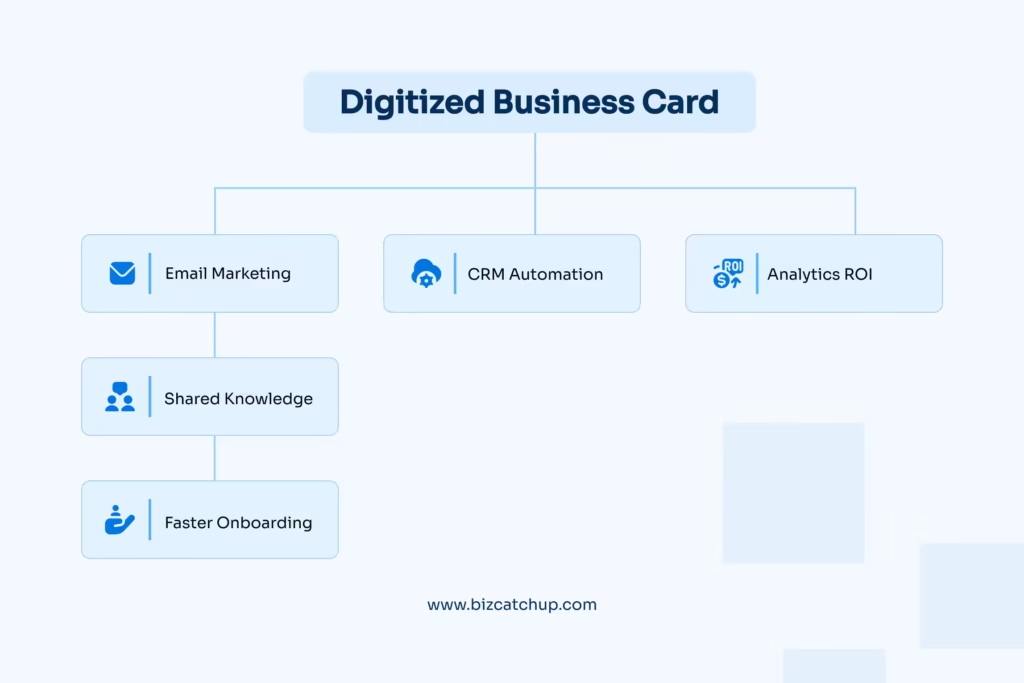
Email marketing segmentation – Marketing segmentation helps to identify digitally tagged contacts after the event, allowing the nurturing of the relationship between a five-second conversation and a continuous marketing relationship to unfold.
Sales pipeline automation – CRM (sales pipeline) automation creates a new task as soon as a digital contact is added, including determining who the assigned salesman will be and when the follow-up call will be made and/or whether this will be classified as a hot lead based on the industry/name mentioned in a business card.
Analytics regarding networking ROI – Network ROI analytics lets you know which events/conferences brought in leads from tagged digital contacts; hence you can figure out where to use your networking budget next year.
Team knowledge sharing – When a good salesperson has left, all the other people in the organization are able to retrieve a complete history of the relationship and contact information thanks to the shared digital contact library.
Faster onboarding for newly hired employees – Onboarding becomes simple thanks to the shared digital card database to look for the number instead of walking around the office and asking, “Does anyone know the supplier’s phone number?”
In short, the real value of learning how to digitize business cards isn’t just decluttering a drawer; it’s converting a one-time introduction into a durable, actionable business asset that compounds over time.
Frequently Asked Questions
1. What is the fastest way of digitizing business data?
The fastest method for most people is a business card scanner app with OCR; it takes about 5–10 seconds per card, including the review step, and saves directly to your contacts or CRM. Apps like BizCatchup go a step further by handling the tagging and CRM sync automatically, so there’s nothing left to do manually after the scan. For occasional single-card scans, built-in tools like Google Lens or Apple’s document scanner are quick enough that a separate app isn’t always necessary.
2. Is it safe to digitize business cards using a free app?
Many free apps are safe, but you should always review the app’s privacy policy before granting camera and contacts access, since business cards contain personal data. Choose apps that clearly state how contact data is stored, whether it’s encrypted, and whether any information is shared with third parties for advertising purposes.
3. Can I digitize business cards without an app?
Yes. You can manually type contact details into your phone or computer, or use a built-in document scanner (like Apple Notes) to save an image, though you’ll lose the automatic OCR-to-contact conversion that dedicated apps provide. This approach makes the most sense for a small handful of cards rather than an ongoing habit.
4. How accurate is OCR scanning for business cards?
Modern OCR-based scanner apps typically achieve 90–98% accuracy on standard, well-lit, printed cards. Accuracy drops for handwritten text, unusual fonts, low lighting, or heavily stylized logos, so a quick manual review of the auto-filled fields is still recommended before saving.
5. Can digitized business cards sync directly to a CRM like Salesforce or HubSpot?
Yes. Most modern scanning apps support direct export or API integration with major CRMs, allowing a scanned card to become a fully formed lead record, complete with tags, owner assignment, and follow-up tasks, without manual data entry. BizCatchup does this automatically the moment a card is scanned, with no separate export step.
6. How do I digitize a large batch of old business cards efficiently?
Sort the cards first to remove duplicates and outdated contacts, then use a batch-scan feature or dedicated scanner to process multiple cards at once, followed by a bulk CSV import into your contacts app or CRM. Spot-checking a sample of the imported records afterward helps catch any OCR errors before they spread through your database.
7. What’s the easiest way to digitize business cards without doing it manually?
Download BizCatchup, scan a card or a stack of cards, and let the app handle OCR, tagging, enrichment, and CRM sync in the background. It’s the closest thing to a fully automated way to digitize business cards, since there’s no manual export or data entry step for you to do afterward.
