
“What do you do?” It’s one of the most common networking questions, and yet not all business cards will have an answer for this question.
“Operations specialist” could mean supply chain management, or it could refer to IT support. When your business card does not create clarity, you lose your opportunity to be remembered.
According to research conducted by the Harvard Business School, there is evidence showing that when meeting others for the first time, people tend to respond much more favorably to someone who has established some type of trust compared to someone who exhibits confidence.
However, individuals have a tendency to sabotage their initial trust in others by using business card titles that are ambiguous or overly grandiose. A person’s business title is an indication of their trustworthiness regarding what they will say or can do in the future.
What Is a Business Card Title and Why It Matters
Your business card title does more than just describe your job. It is the first professional message that is sent before any conversation takes place.
While your name is your individual identity, your title tells others about what you do and the value you provide, as well as the type of connection between you and the rest of your organization.
Why it matters:
Instant clarity: In a networking setting with dozens of cards exchanged daily, your title reveals whether you are simply recognized as “that marketing person” or identified for your unique abilities and dimensions of authority.
Establishing yourself: Your title indicates your decision-making capacity and relevance to potential clients, business partners, or collaborators. A “Head of Sales” has different expectations from a “Sales Associate”, even though their job functions may be similar.
Starting Up a Conversation: Proper business card titles give you natural conversation starters. “Growth Architect” invites questions that “Manager” doesn’t. A strategic title can create an opportunity to have much deeper discussions about your work.
Common Issues
As valuable as titles on business cards can be, they frequently fall short:
- Use of generic jargon (e.g., “Business Development Executive”) that has no specific meaning
- Use of creative titles that are confusing instead of clarifying (e.g., “Chief Happiness Officer”)
- Obsolete titles that do not reflect your current job position or market positioning
- Inconsistency in the title on the card compared to LinkedIn
Title discrepancies often create unnecessary friction in future communications, making it harder for others to remember and connect with you.
Key Factors to Consider When Choosing the Title
You need to balance the authenticity, what the audience expects, and how your title fits in your field to choose the best title for the business card.
Your Actual Job and Responsibilities
Your actual job and responsibilities should be reflected in your business card titles. If you are responsible for managing partnerships and your title is “Strategic Alliance Director,” this could lead to miscommunication later in the conversation. Enlarging your title is not a way to build credibility, but will actually reduce trust.
Ask yourself: Can I back up this title in a 30-second conversation? If someone asks, “What does that involve?” will your answer match their expectations? If not, simplify.
Your Target Audience
Consider who receives your smart business card. For example, “Growth Hacker” might appeal to new businesses, but could confuse larger companies that would expect “Marketing Manager”.
Businesses in conservative industries will generally use conventional titles, while there is more room for creativity within businesses in other creative sectors.
Strategic approach: If you are trying to reach multiple audiences, consider how your title relates to the context. Are you meeting with an enterprise client? You would want to use standard language. If you are networking at a technology conference, creative positioning would be acceptable.
Industry Norms and Expectations
Different fields handle business card titles differently:
- Technology start-up companies: Standard title is “Head of Product”; traditional, corporate environments often use the term “Product Manager”.
- Agencies: The term “Account Director” indicates service models that differ from “Client Success Manager”.
- Consultants: The job title “Principal” or “Consultant” carries a much different level of respect
- Real estate: “Advisor” in luxury markets signals expertise, while the same title in commercial real estate might seem junior. Context matters!
Pro tip: Research competitors and industry leaders in your market. What titles do they use? This isn’t about copying—it’s about understanding the language your audience already speaks.

Choosing the Right Title by Career Stage
Your title strategy should evolve as you progress in your career.
Strategy for Entry-Level and Early Career
Use well-known titles to create realistic expectations, like “Marketing Coordinator” or “Junior Developer”. Titles that don’t accurately represent your level of experience will cause problems.
Middle-Level Professionals
Differentiation is important at this stage. Rather than using a generic title like “Account Manager,” business card titles such as “Enterprise Account Manager” or “Strategic Partnerships Lead” communicate your level of specialization and experience.
Senior Leaders
If you’re not sure about which title to use, choose a specific title to describe the area in which you make decisions, for example, “VP of Sales” instead of “VP of Business Operations.” Your role must align with the title you hold.
Founders, Entrepreneurs, and Freelancers
“Founders” typically refer to established businesses as opposed to being used to denote those who work alone as entrepreneurs.
It is common for people with functional job titles such as “Fractional CFO” or “Brand Consultant” to have meaningful conversations with clients rather than just having the term “Entrepreneur” applied to them.
Business Card Titles vs. Job Titles: Should They Be the Same?
Not necessarily. Your job title is for HR and for internal hierarchy, while your business card title serves to position you externally and convey your message clearly.
For example, if you are a “Customer Success Specialist II” internally, you could be referred to as a “Customer Success Manager” on your business card. If you are the “Associate Director of Strategic Initiatives”, consider whether being called “Strategy Director” means more to you in terms of clarity.
Ultimately, you want your smart business card to accurately reflect who you are, but it also should be optimized based on how you would like to be seen and remembered. Your business card should match your LinkedIn profile to ensure consistency across all points of contact.
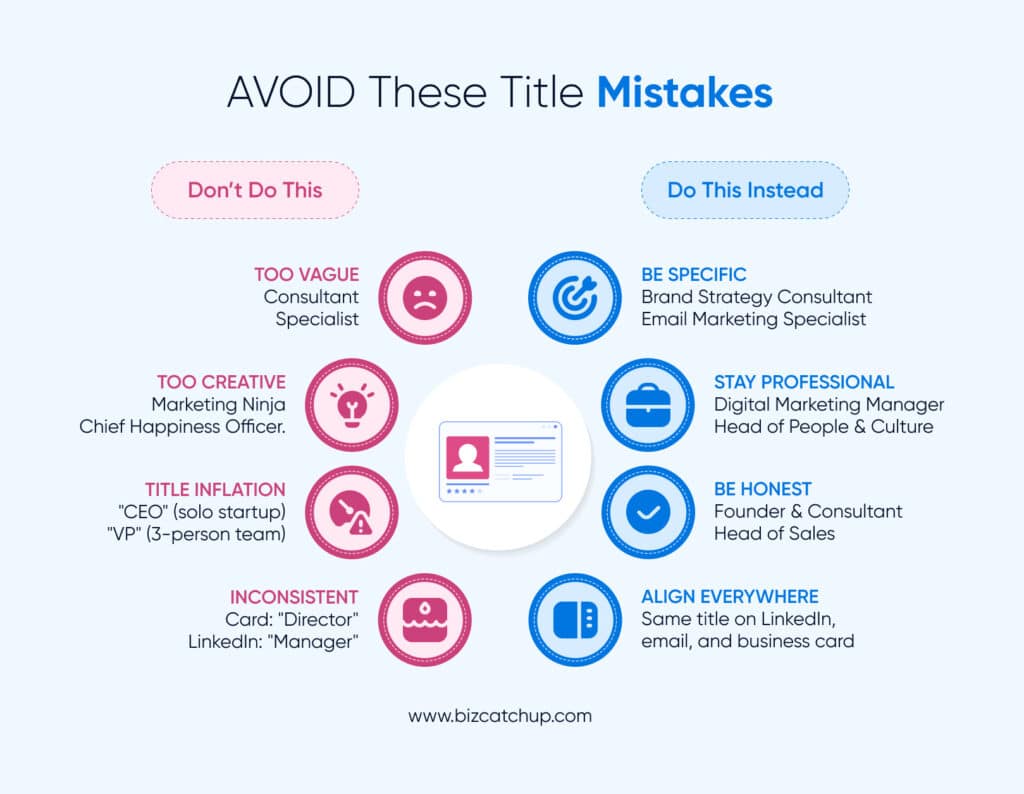
Common Mistakes to Avoid
When you’re choosing your business card title, don’t make these mistakes:
- Being Too Vague: “Consultant” or “Specialist” doesn’t offer the reader any context.
- Too Creative: Creative and unique branding can result in your business card titles (e.g., Marketing Ninja) having an unprofessional appearance, where it’s better to keep it simple.
- Title inflation: Calling yourself “CEO” of a one-person startup creates credibility issues.
- Lack of Consistency: Using different titles on your business card, your LinkedIn profile, and email will cause readers to be confused.
- Not Knowing Your Audience: Using acronyms, jargon, and terminology that your contacts don’t understand will make your title irrelevant.
- Copying competitors: Blending into your competitors will make it impossible for you to stand out from the crowd.
Knowing how to create a business card that backs up your title can help avoid these mistakes.
How Digital Business Cards Allow Smarter Title Customization
Digital business cards address an issue that paper business cards cannot fix: context-specific positioning.
With platforms and digital business card apps, such as BizCatchup, you can modify your title according to the person you meet. You can be an “Account Director” when meeting with a corporation, or a “Growth Lead” when you are networking at a startup event. Your title will change based on your audience without having to reprint multiple cards.
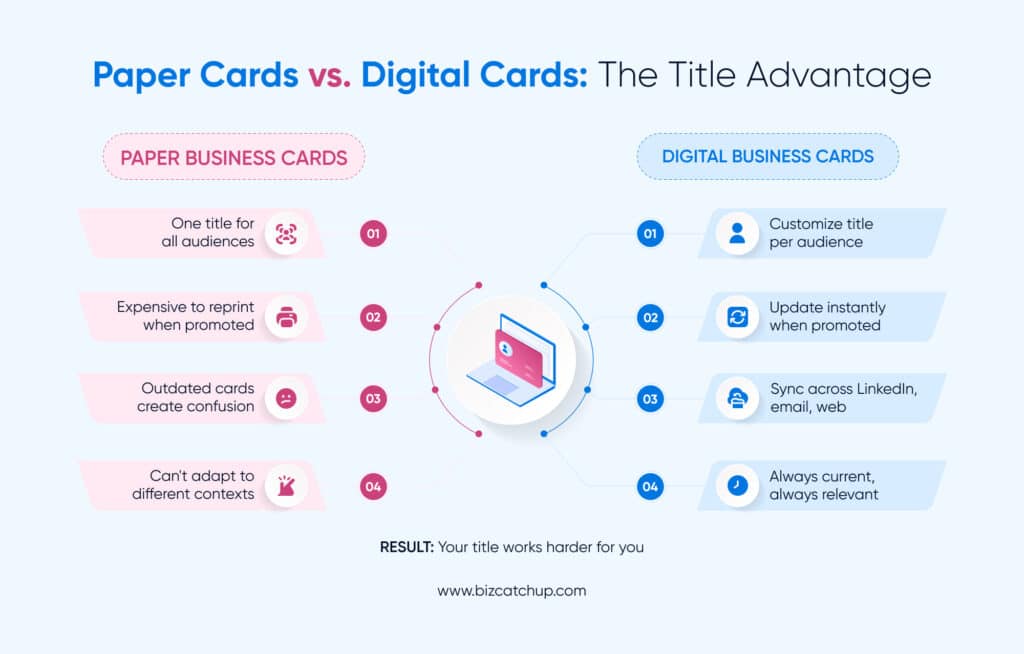
With digital cards, your card is synchronized across different platforms (your digital card, LinkedIn, and email signature), so that everything is consistent moving forward.
Plus, you are able to automatically update your title whenever it changes, meaning when you get promoted, you avoid the awkward situation of saying, “I’ve been promoted since I printed these business cards.”
Final Thoughts
The title on your business card should be considered a strategy instead of simply an element of formality. It creates a first impression, opens the door for conversation, and establishes your position within your industry.
Think of business card titles that represent who you want to be remembered as, and it should be clear and honest, because clarity is currency when it comes to networking.
Quick Catch
How do I choose the right business card titles for networking events?
Your title on a business card should indicate what you do and why it matters. Focus on functional clarity rather than internal job labels so that new connections can easily understand your function and initiate appropriate conversations with you.
Should business card titles be different from my official job title?
It is true, your business card title will not always match your HR job title. The clarity and relevance of your title to an external audience must outweigh the structure of your official title, which is typically based on internal hierarchy.
What are the most common mistakes people make with business card titles?
Some of the common blunders of modern business cards include vague or overly creative title descriptions and using technical jargon instead of common language. All of these confuse recipients and decrease their level of trust in you and your abilities as a professional.
How often should I update my business card title?
When an individual’s responsibilities, audiences, or position change, updating your business card title is required. An outdated or inaccurate title may represent you incorrectly and can result in limiting your opportunities, especially in fast-paced or event-driven networking environments.
Can digital business cards help customize business card titles?
Yes, digital business cards allow individuals to update and customize their business card titles based on the audience or event they are attending. This allows a person to maintain a clear, consistent, and relevant message without requiring them to reprint their physical business cards.
