
Corporate employees hand out cards backed by companies like Google, McKinsey, or Goldman Sachs. Consultants hand out cards backed by… themselves. It fundamentally alters everything.
According to research conducted by the Institute of Customer Service, 81% of consumers believe that establishing trust with a company will factor into their decision of whether or not to do business with that company.
A consultant’s business card serves as an authority on that consultant’s competency, rather than merely being used to share contact information. Get it wrong, and you’re another forgotten contact. Get it right, and you’re positioned as the expert they’ve been searching for.
Why Consultant Business Cards Need a Different Approach
Unlike corporate employees who carry the weight of an established brand, consultants ARE the brand. Consultants thus require a strong business card that will convey credibility and confidence in the absence of a company logo.
Consultants need to pay closer attention to each element of the business card than corporate employees do. A corporate “Marketing Manager” working for Google automatically has brand recognition due to their affiliation. However, a “Marketing Consultant” has to demonstrate their expertise, specialisation, and trustworthiness through the actual card itself.
Your consultant business card serves as a portfolio, credential display, and first impression all combined into one single item. It answers the silent question potential clients have in their minds: “Why should I trust you with my business?”
Essential Elements for Consultant Business Cards
Your Title: Specificity Over Ambiguity
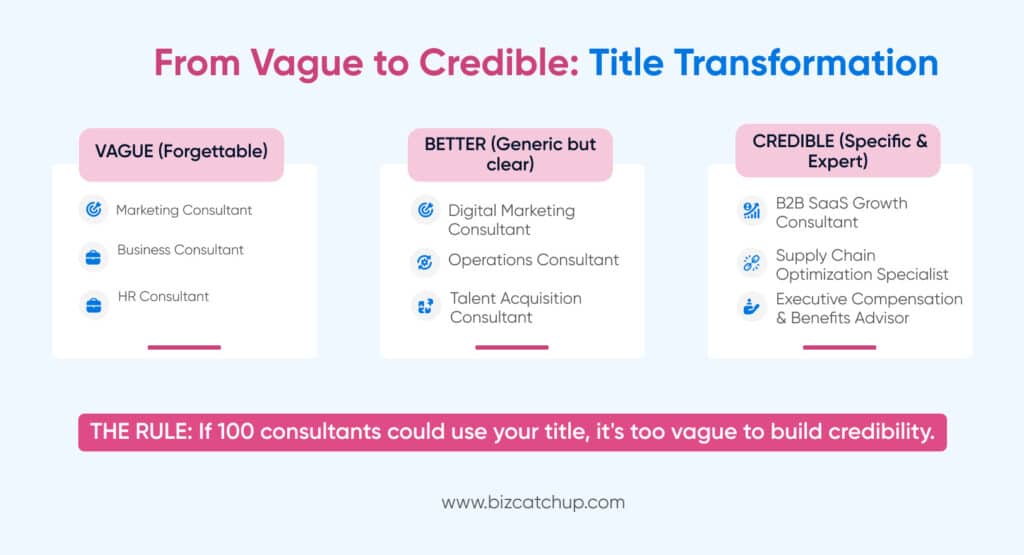
Using a generic title is a great way to lose credibility with potential clients. Simply saying “Marketing Consultant” does nothing to convey whether or not the client can trust you to solve their issue.
Compare these alternatives:
- Vague: Marketing Consultant
Specific: B2B SaaS Growth Consultant
- Vague: HR Consultant
Specific: Executive Compensation & Benefits Advisor
- Vague: Business Consultant
Specific: Supply Chain Optimisation Specialist
Expertise can be shown through specific titles. A CEO looking for assistance with cash flow will hire a “Financial Planning and Analysis Consultant”, not the generic “Finance Consultant.”
Credentials and Certifications
Strategically placing credentials creates credibility very quickly, but only if they are relevant to your area of consulting.
Credentials to include when they apply:
- For financial consultants:
CPA, CFA, or CA (worldwide), ACCA (UK or Commonwealth), and CPA Australia or CA ANZ (Asia-Pacific).
- For project management consultants:
PMP (worldwide), PRINCE2 (UK or Europe), and AgilePM (international).
- For strategy consultants:
MBA or EMBA (worldwide).
- For operations consultants:
CMC (worldwide) and Certified Six Sigma Black Belt or Lean Six Sigma (international). - For HR and talent consultants:
SHRM-SCP (US) and CIPD (UK or Commonwealth).
- For management accounting consultants:
CMA (worldwide) and CIMA (UK and Commonwealth).
Where to place: After your name (Jane Smith, CPA) or a discreet footer, and never let them overshadow your value proposition.
Do not include credentials that do not help with positioning. A marketing consultant shouldn’t have “Licensed Real Estate Agent” listed on their consultant business cards, as it demonstrates a lack of focus and raises doubt about their level of commitment.
Value Proposition in a Glance
The best business cards for a consulting firm answer the question “What do you actually do?” in a single line below your title and can be easily scanned.
Examples of effective value propositions are:
- “Helping mid-market SaaS companies grow from $5M to $50M in annual revenue.”
- “Lower manufacturing supply chain costs by 15%-30%”
- “Executive leadership coaching for first-time CTOs”
By leveraging the one line on your smart business card as a value proposition, you build the reputation of your consulting firm through three elements that are critical for determining whether somebody hiring a consultant or consulting firm would hire you: Focus, measurable results, and target market.
Contact Information Strategy
What you include matters as much as what you exclude.
Must include:
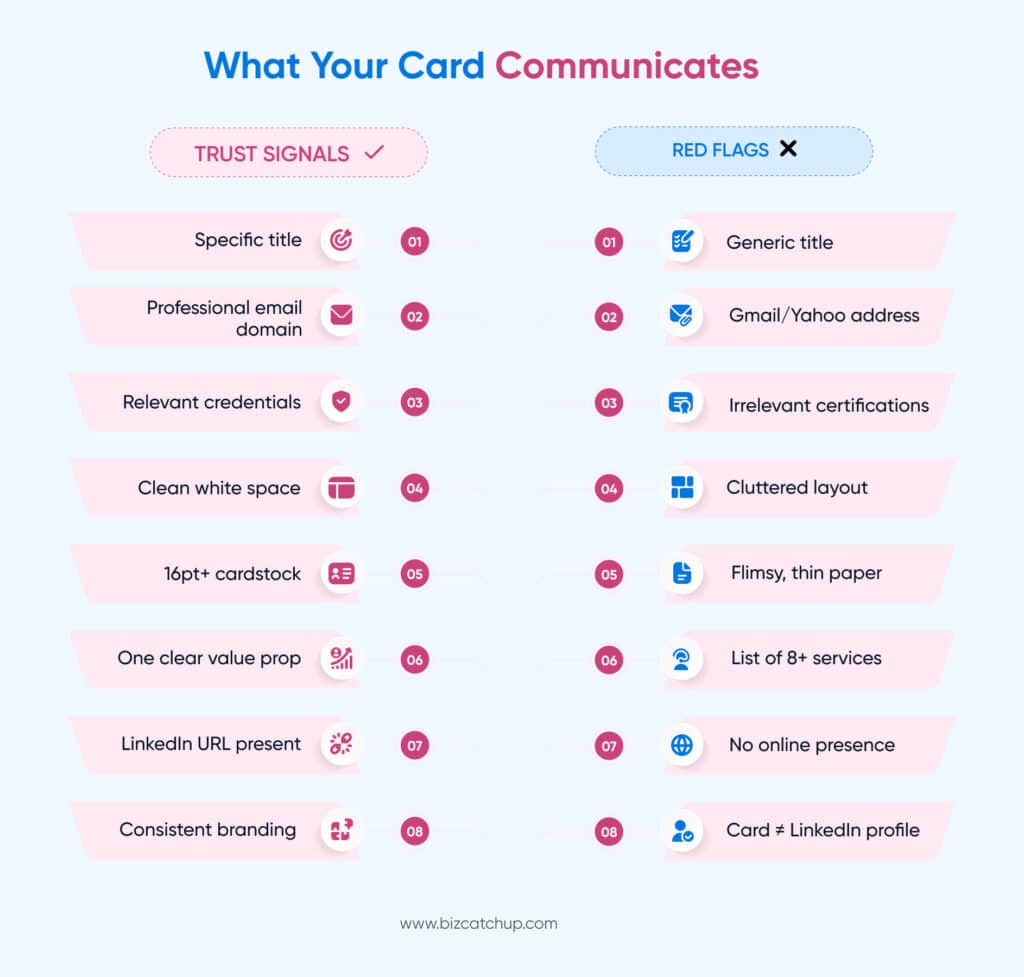
- A professional email, with its own domain, as it reflects professionalism (something like [email protected]). Don’t use Gmail or Yahoo as a domain.
- Direct phone number
- LinkedIn URL, it acts as a modern credential validator
- City or region, if local presence matters
What not to include in your consultant business cards:
- Physical office address, as many consultants work remotely
- Fax numbers, as they are dated and irrelevant.
- Multiple phone numbers because it creates confusion.
Design Principles That Signal Professionalism
The design of your card tells potential clients the type of work you do even before they have spoken to you.
Clean layouts signal strategic thinking. Cards that are cluttered and have many fonts, colours, and graphics imply a lack of focus. Limit your card to a maximum of 2-3 colours and use only 1 complementary font pairing.
Material quality matters exponentially for consultants. If you present a flimsy card, it diminishes the value of the $15K consulting proposal. Purchase cards that are of at least 16pt card stock to provide tactile substance, or even better, a digital business card.
White space communicates confidence. Putting every certification and service on your consultant business cards communicates insecurity. Use of strategic empty space communicates, “I don’t need to oversell.”
Typography choices matter. The font you choose also says something about who you are and your area of expertise.
- Serif fonts (Times, Garamond, etc.) communicate that you are a tradition-based expert, and are ideal for consultants in law, finance, or executive consulting.
- On the other hand, Sans-serif fonts (Helvetica, Open Sans, etc.) communicate that you are a modern, tech-oriented consultant, ideal for consulting in digital, start-up, or innovation.
Colour psychology in action:
- Navy or charcoal = Trust, stability (financial, legal consultants)
- Green = Growth, sustainability (environmental, business growth consultants)
- Orange or red = Energy, urgency (sales, marketing consultants)
- Black and white = Sophistication, premium positioning (executive, luxury consultants)
Knowing how to make business cards is important to make a card that stands out.
Common Mistakes That Destroy Consultant Credibility
Listing every service you offer. “Strategy, Marketing, Operations, HR” gives the impression of desperation rather than expertise. Specialists charge higher fees while generalists compete based on price.
Using overly creative designs. Unusual shapes and too many graphics are considered unprofessional. Leave your creativity for the solutions you provide and not the consultant business cards you hand out.
Outdated contact information. A dead link to your website indicates you have poor management skills. Therefore, it’s unlikely to be trusted with someone else’s business.
Card and online inconsistency. Your business card says you’re a “Growth Strategist” and LinkedIn says “Marketing Consultant”, both of which destroy your credibility instantly.
Cheap materials. Using cheap materials to make business cards will cause people to assume that you will cut corners on your projects as well.
Generic stock imagery. Nothing screams “amateur” faster. If you’re unable to make the investment in having a professionally designed card, then stick with text-only layouts.
Digital vs. Physical: The Consultant’s Strategic Choice
Smart consultants don’t choose between digital and physical cards—they use both strategically.
Physical business cards are essential for:
- High-stakes client meetings where tactile professionalism matters
- Industry conferences where quick exchanges take place
- Traditional industries (finance, legal, and real estate) that place a high value on tangible credibility
Digital consultant business cards have advantages that physical cards cannot provide:
- Real-time updates when you earn new qualifications or change specialisations
- Ability to track engagement with your card, like which users viewed your card and when
- Ability to instantly share your card with a QR Code, email or text
- Integration with your portfolio—you can link directly to your case studies and testimonials
- Environmental positioning for your environmentally-conscious clients
Platforms like BizCatchup will allow you to customize your card based on your target client. Meeting enterprise clients? Present your corporate credentials. Pitching startups? Present your experience in agile delivery.
By using a digital business card app to customize your digital cards for your target clients, you no longer have to distribute hundreds of physical cards for all potential clients.
The winning approach: Use digital business cards for networking events, follow-up calls, and long-term relationship management—all from one place.
Final Thoughts
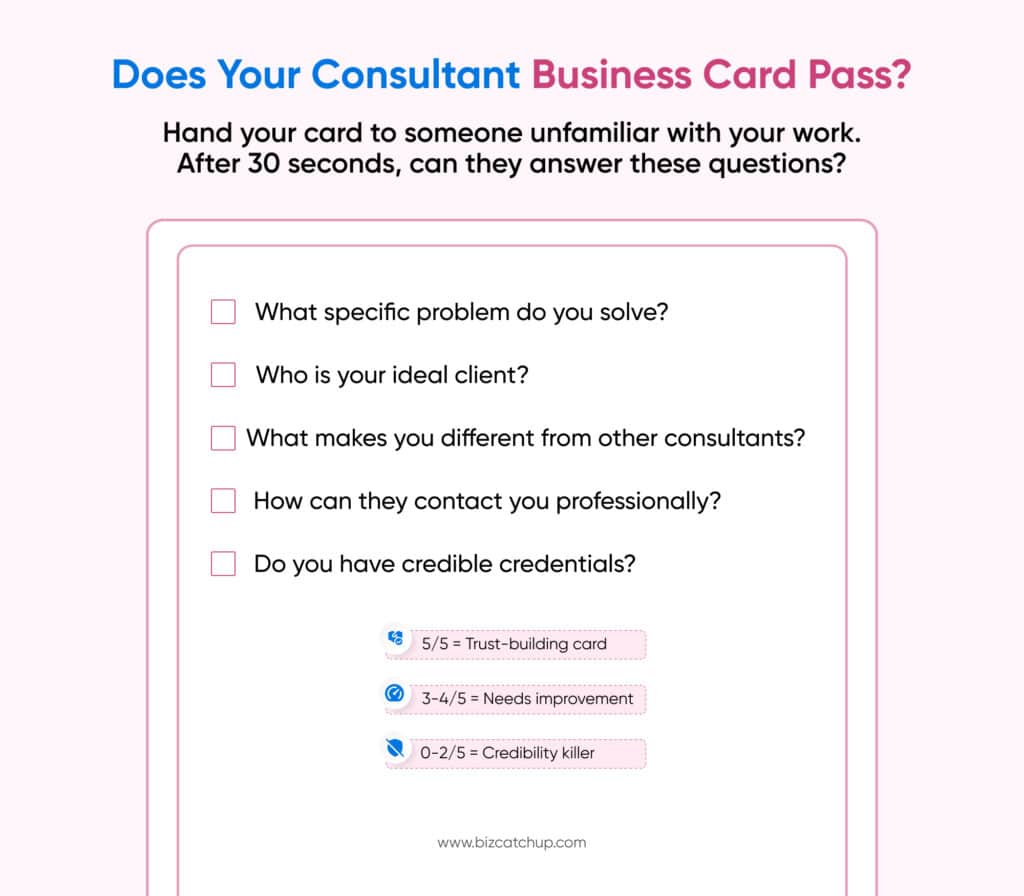
Your consultant business cards aren’t just contact information—they are a trust signal that determines whether prospects see you as an expert or another option. Every element, from title specificity to material quality, should reinforce credibility.
Therefore, whether printed or digital, high quality is a must because it sends a message to clients about how much you value the work they provide to you.
Good consultant business cards should contain a non-generic title, professional domain email address, relevant credentials, and a clearly defined value proposition. Use quality materials (16pt+ cardstock) and a clean design that signals professionalism.
Avoid using vague job titles, cheap printing, or listing multiple services that have no relation to each other, as doing so can be detrimental to your credibility.
Consultants build trust by being precise and having high-quality services. You should choose a specific title that demonstrates your expertise, offer measurable value in terms of what you can deliver, show appropriate credentials, and use quality materials.
It is also important to ensure consistency between your consultant business cards and your LinkedIn profile. Every element should reinforce that you are a specialist, not a generalist.
Independent consultants can take advantage of both types of consultant business cards. Physical cards are best utilised for face-to-face meetings and in traditional industries, while digital business cards can provide immediate access to your contact information and allow for real-time updates and customisation based on the audience at a network event.
Include your name, specific consulting title, one-line value proposition, professional email domain (not Gmail), direct phone, and LinkedIn URL. Include relevant credentials (e.g., CPA, MBA, PMP) only if the client can recognise their value for the specific services you provide. Do not include your physical address, fax number, etc., which would cause clutter and confusion.
Select the most specific title that you will use to identify your services. Replace “Marketing Consultant” with “B2B SaaS Growth Consultant” or “HR Consultant” with “Executive Compensation Advisor.” If your title is too generic and similar to those of other consultants, you lose all credibility with your prospective customers.
